

If your Linux infrastructure runs eBPF security agents, you may be burning significant kernel CPU on repetitive path resolution. Every time a database like Postgres opens a file, the eBPF hook walks the entire parent directory tree to verify policies. Running this slow path on every single file access wastes expensive compute resources, but throwing complex AI models at kernel-level performance bottlenecks is the wrong fix.
By applying classical memoization through an inode-based cache, open-source developers recently slashed kernel CPU consumption by 90%. This guide breaks down practical eBPF performance optimization techniques, showing you how caching mount IDs and inode numbers eliminates redundant directory walking, stabilizes system performance, and cuts cloud infrastructure costs.
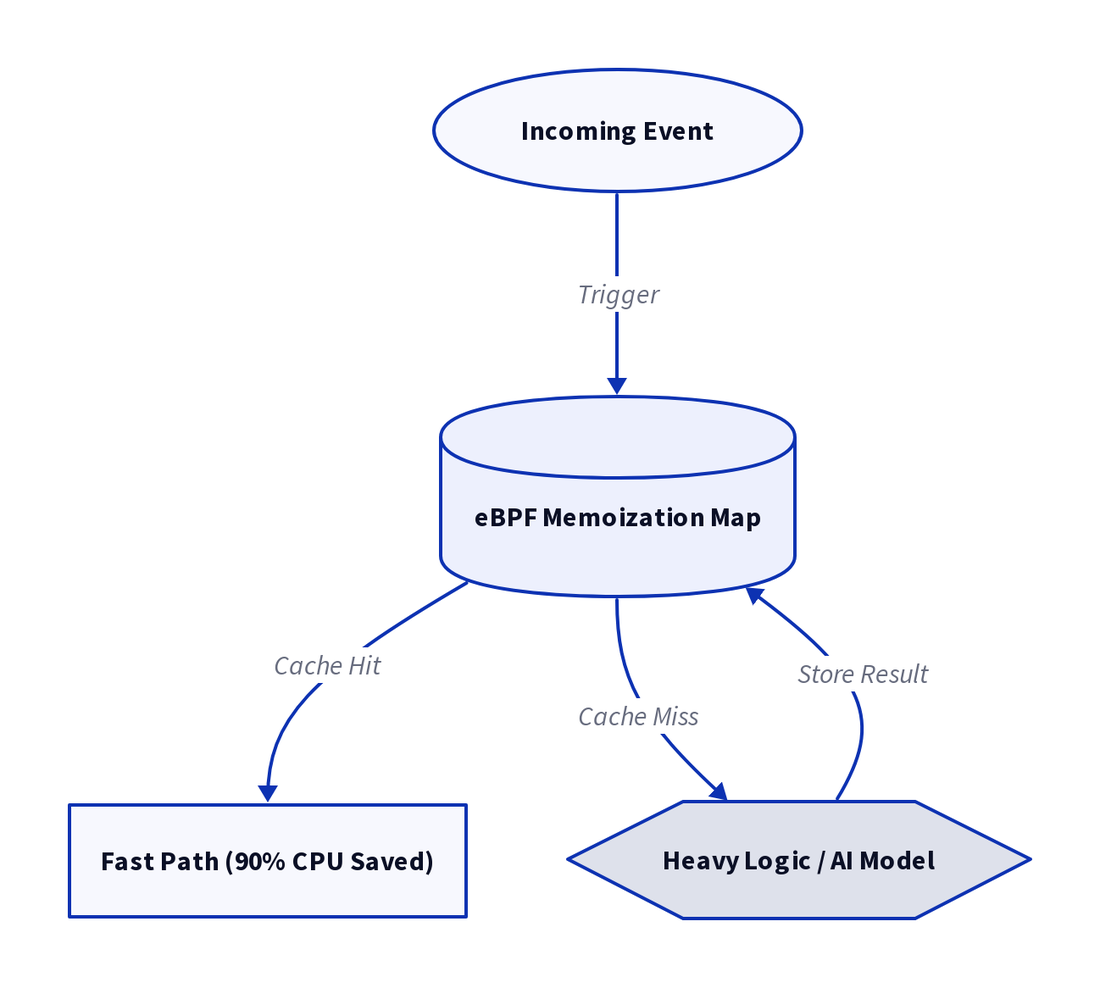
The Hidden Compute Tax of Kernel-Level File Path Traversal
When an eBPF agent relies on a Linux Security Module (LSM) hook triggered during file access, every operation forces the kernel to resolve file paths from scratch. To evaluate access policies, the agent walks up parent dentries step by step to build the complete directory structure. This structural traversal happens before policy enforcement even begins, consuming CPU cycles on every single call.
For high-frequency database workloads, this design creates severe kernel space overhead. High-throughput engines like PostgreSQL frequently access nested directory structures such as var/lib/postgres/data/base/. Re-evaluating the same parent directory hierarchy thousands of times per minute wastes compute resources on work the system has already performed.
This repetitive execution is the core driver of excessive eBPF CPU cost in production systems. Infrastructure teams often mistake this kernel-level bottleneck for genuine workload scaling, masking a pure architectural inefficiency behind higher hardware bills.

How Inode-Based Memoization Eliminates Repetitive Path Walks
Designing a composite cache key without pointer overhead
Storing raw Linux dentries directly inside eBPF maps presents a structural hurdle. Dentries rely on in-memory pointers, which eBPF map infrastructure cannot natively store. Attempting to copy full dentry contents into static structures creates bloated key definitions, increasing kernel space overhead and consuming memory without delivering speed benefits.
To bypass pointer limitations, open-source author Nathan Naveen designed a composite cache key using numeric file identifiers instead of full path strings. Because inode numbers are unique only within a single filesystem mount, a standalone inode number cannot guarantee safe policy isolation across containers. The agent resolves this by merging three distinct attributes into a compact key:
- The filesystem device ID to pinpoint the exact storage volume.
- The 64-bit inode number that uniquely tracks the object within that volume.
- The mount namespace ID to prevent security boundary leaks across isolated container layers.
Packing these three integer values into a 16-byte structure allows the eBPF program to run an O(1) map lookup instead of walking the dentry tree on every system call. Path resolution in the Linux kernel regularly consumes hundreds of CPU cycles per event as it iterates through parent directories and verifies permissions. Caching the resolved security context directly in a kernel hash map converts a costly traversal into an immediate memory fetch.
This pattern highlights a core truth of eBPF performance optimization. While observability platforms increasingly deploy machine learning to analyze system telemetry, classical computer science techniques like memoization achieve far greater efficiency at the kernel level. Heavy AI models demand significant memory overhead and introduce unpredictable latency spikes. A simple lookup table operates deterministically, eliminating CPU work before it occurs.
The financial impact on infrastructure costs is immediate. When microservice clusters execute millions of file operations per second, saving dozens of instruction cycles per lookup compounds rapidly. Stripping away unnecessary path evaluations reduces core CPU usage across cluster nodes, lowering cloud computing spend without relying on expensive external predictive modeling.
The Business ROI of a 90% Kernel CPU Cost Reduction
Lowering operational infrastructure spend
Security monitoring should never force an unexpected tax on compute budgets. When background agents burn kernel cycles continuously traversing directory paths, operations teams must over-provision virtual machines and bare-metal nodes to preserve baseline performance. Slashing this overhead directly reduces the compute capacity required to sustain enterprise operations.
The open-source bomfather/agent project demonstrates the practical financial impact of this eBPF performance optimization strategy. By dropping kernel CPU cost by 90%, engineering teams can safely increase workload density across existing clusters. This operational efficiency translates into smaller cloud instance footprints, lower server counts, and reduced hardware spending across enterprise deployments.
Rather than purchasing additional nodes to offset agent resource consumption, organizations reclaim processing power already present in their infrastructure.
| Execution Approach | Kernel CPU Impact | Operational Consequence |
|---|---|---|
| Path Traversal (Slow Path) | High overhead per file open | Forces node over-provisioning |
| Inode Memoization | 90% CPU cost reduction | Reclaims server capacity |
Preserving runtime bandwidth for core workloads
Compute cycles spent walking directory trees inside kernel space are cycles taken directly from line-of-business applications. High-throughput database engines, automated manufacturing platforms, and enterprise software require predictable CPU access to hit operational targets. Eliminating redundant kernel resolution stops security tools from competing with primary workloads for hardware resources.
Excessive kernel execution creates noisy neighbor conditions, where background security checks cause unexpected latency spikes in critical production pipelines. Memoized inode lookups replace dynamic directory resolution with constant-time map reads, ensuring security overhead remains flat under heavy load. Operations leaders maintain high transactional throughput and consistent application quality without disabling essential host-level security controls.

Why Deterministic Algorithms Beat AI Models in Systems Engineering
Avoiding model overhead in latency-sensitive kernels
Kernel-level operations demand predictable execution timelines measured in nanoseconds. Attempting to deploy machine learning models or probabilistic predictors inside a Linux Security Module (LSM) hook introduces unacceptable latency and memory overhead. Complex inference engines consume substantial compute cycles just to calculate probability scores, which defeats the core objective of latency reduction in high-throughput environments like database nodes.
In low-level infrastructure, predictable performance profiles matter far more than pattern guessing. An eBPF program operates under rigid kernel verifier constraints that enforce strict limits on instruction counts and memory access. Deterministic algorithms execute in constant time O(1) without unpredictable branching or heap allocations, ensuring system calls proceed immediately without delaying core business workloads.
Prioritizing classical data structures over complex software
Engineering teams frequently reach for hyper-complex software layers when foundational computer science techniques solve the underlying problem faster and cheaper. As demonstrated in recent open-source security agent benchmarks, replacing repetitive parent dentry walks with an inode-based lookup table dropped kernel CPU overhead by 90%. Simple memoization targets root-cause computational waste directly at the data layer without introducing fragile external dependencies.
Structuring cache keys with specific numeric identifiers, combining mount namespace IDs, mount IDs, and inode numbers, allows eBPF maps to store exact match states safely. Choosing fundamental data structures over complex software architectures yields immediate eBPF performance optimization without model retraining or infrastructure bloat.
The technical trade-off between complex software models and classical memoization highlights why basic algorithms remain superior for kernel-level tasks:
Ready to find AI opportunities in your business?
Book a Free AI Opportunity Audit. It is a 30-minute call where we map the highest-value automations in your operation.
Designing Lean Systems Before Scaling Compute Complexity
Auditing high-frequency kernel interactions
Operations leaders and engineering directors must audit low-level system calls before approving infrastructure budget increases. Profiling reveals whether performance bottlenecks stem from genuine hardware limits or redundant system routines. When background services execute millions of operations per second, small inefficiencies in kernel execution accumulate into massive compute bills.
Security monitoring agents provide a clear example of why this auditing matters. Profiling the execution path of the open-source bomfather/agent project revealed that evaluating security policies on file opens consumed far more CPU cycles than enforcing the actual policy decisions. Isolating that specific path resolution bottleneck allowed developers to target the exact function causing system overhead.
To systematically audit kernel-level workloads, technical teams should focus on three primary metrics:
- Routine frequency: Count how often specific system hooks execute during peak database operations.
- Redundant executions: Identify repeated calculations performed on static inputs across short timeframes.
- Resource footprint: Measure the exact CPU cycle cost per execution inside kernel space.
Establishing baseline benchmarks before redesigns
Engineering teams frequently attempt to solve latency issues by over-provisioning virtual machines or adding complex software layers. A disciplined performance strategy requires establishing clear execution baselines before making architectural changes. Measuring latency and CPU usage at the function level provides an objective standard for evaluating optimization attempts.
Capturing precise performance baselines allows system architects to verify whether a technical fix delivers real operational gains. Benchmarking eBPF performance optimization strategies showed that replacing repeated dentry traversals with cached lookup states eliminated 90% of kernel CPU cost. Deterministic fixes backed by accurate baseline metrics consistently outperform speculative infrastructure expansion.
| Optimization Step | Target Outcome |
|---|---|
| System Profiling | Isolate expensive kernel hooks and repetitive execution paths |
| Baseline Benchmarking | Quantify CPU cycle usage and execution latency before changes |
| Targeted Refactoring | Apply lean algorithms like memoization to eliminate wasted compute |
Source: nathannaveen.dev