

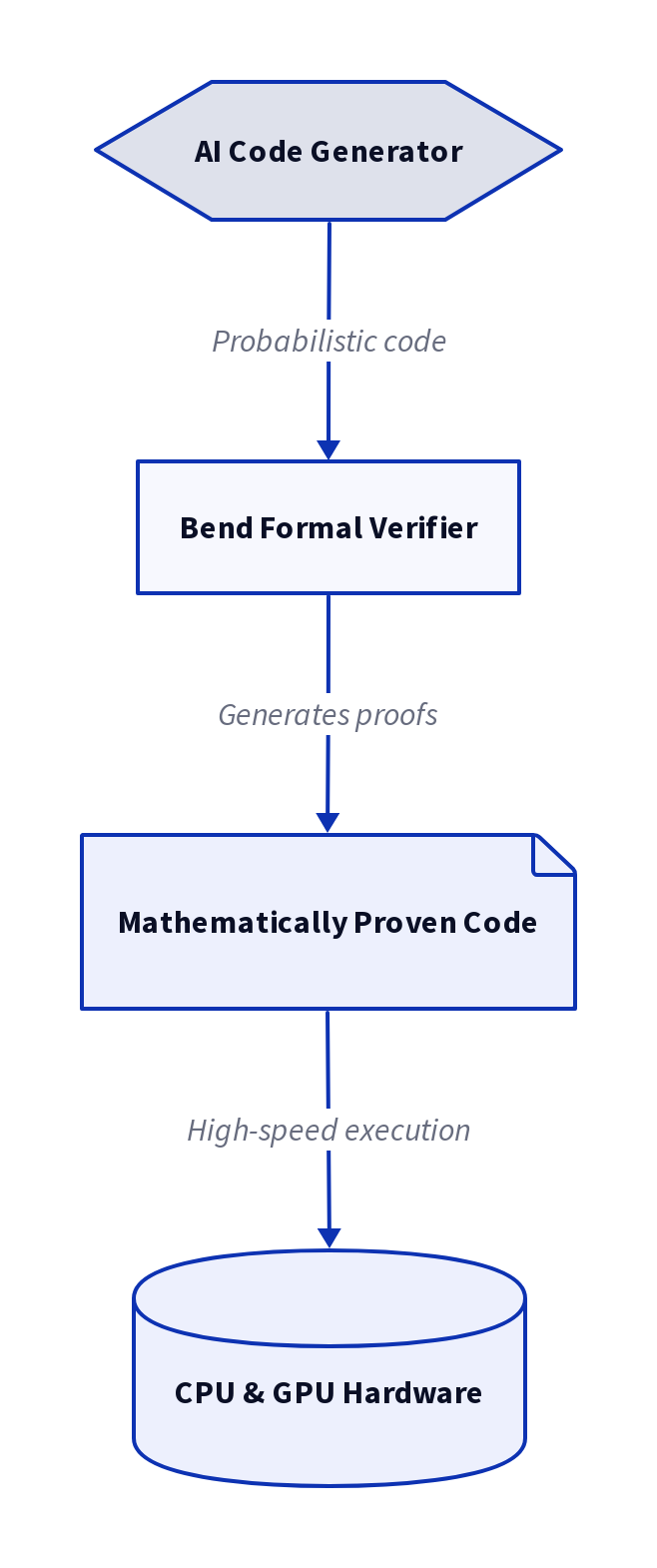
When you let AI agents generate production code, you rely on probability rather than certainty. Subtle hallucinations slip past code reviews, forcing your engineering team to audit every line manually. Bend changes this equation by embedding mathematical proof verification directly into the development workflow using simple Python syntax. Through formal constraints written in LAWS.bend, the compiler blocks unproven AI changes automatically. It transforms AI code verification from a blind trust exercise into a rigid, type-checked theorem.
This article breaks down how Bend delivers mathematical correctness without sacrificing execution performance. You will see how its compiler validates proofs in under 0.4 seconds, how it scales across 4,096 GPU cores for a 124x speedup, and how to implement formal laws to eliminate AI-generated bugs from your deployment pipeline.
The High Cost of Unchecked AI Code in Production Systems
Deploying AI agents to write software accelerates output, but human code reviews quickly fail under heavy volume. Operations leaders cannot manually audit thousands of machine-generated lines without missing subtle edge cases. When organizations rely on vibe-coded apps built on raw probability, unverified logic slips directly into live manufacturing and operational environments.
The core issue stems from natural language ambiguity. Prompting an agent to update complex workflow rules often introduces silent regressions that standard unit tests fail to catch.
“In the post-AGI economy, humans will eventually stop writing and reading code, but we still need an ambiguity-free way to tell the AIs building the world around us what we want done.”
Without strict AI code verification, higher generation velocity simply pushes flawed logic into critical production systems faster.

How Bend Combines Lean Proofs with C-Level Execution Speed
Traditional formal verification systems force engineering teams to choose between mathematical rigour and execution performance. Bend removes this trade-off by pairing Python-style syntax with a Lean-inspired proof checker that compiles directly into C and CUDA native code.
Sub-second proof checking for live AI agent loops
Standard proof assistants like Isabelle and Agda often stall automated workflows, taking over five minutes to evaluate mid-sized codebases. Even Rocq requires 6.04 seconds, and Lean takes 19.2 seconds to process complex type structures. Bend completes proof checking across 3,200 generic instantiations in just 0.38 seconds on Apple M4 Max hardware.
| Verification System | Proof Check Time (3,200 Instantiations) |
|---|---|
| Isabelle / Agda | >5 minutes |
| Lean | 19.20 seconds |
| Rocq | 6.04 seconds |
| Bend | 0.38 seconds |
This sub-second speed transforms AI code verification from an occasional batch task into a continuous feedback loop. Because verification happens instantly, an AI agent can execute bend PROOF.bend after every individual prompt. The language blocks mathematical logic errors at compile time, forcing the agent to resolve failing assertions before code ever reaches human reviewers.
Automatic multi-core CPU and GPU parallelization
Formal correctness holds little value if the underlying application runs slowly in production environments. Bend generates native binary code capable of running alongside raw C performance. In benchmark tests running the Game of Life algorithm on a single CPU core, Bend finishes in 7.80 seconds, approaching native C at 6.78 seconds while running faster than Lean at 13.8 seconds and TypeScript at 18.8 seconds.
Scaling this performance across hardware requires no manual threading, mutex locks, or handwritten CUDA kernels. Distributing work across 16 CPU cores cuts execution time down to 0.65 seconds, representing a 12x speed boost. Offloading that same binary directly to GPU hardware yields a 124x speedup at 0.06 seconds, delivering mathematical certainty without compromising execution throughput.
Eliminating Merged Bugs with LAWS.bend and PROOF.bend
Defining explicit business invariants in LAWS.bend
Standard software development relies on written requirements and pull request reviews to protect core operational logic. When autonomous agents generate code, natural language instructions in prompt files frequently lead to silent regressions. Bend replaces open-ended prompt engineering with rigid mathematical constraints defined inside LAWS.bend. This file acts as an immutable contract, specifying exact logical invariants that the software must satisfy under every possible execution state.
Instead of hoping an AI agent respects operational boundaries, you declare them as formal equations. For instance, a rule can dictate that a sequence of actions never triggers an illegal state, written cleanly like is_won(board) == False{}. In practice, LAWS.bend serves as an AGENTS.md specification backed by mathematical proof. Stating “make no mistakes” is no longer a soft instruction for the LLM, but a strict requirement checked by the compiler itself.
Forcing agent retries until formal proofs validate
When an AI agent updates a codebase, it must write a corresponding formal proof in PROOF.bend before committing. The development pipeline runs bend PROOF.bend to check that the new application logic preserves every invariant. If a proposed feature violates a law, the compiler rejects the build instantly. Unproven modifications never reach the main branch, blocking broken code at the local agent level.
This automated feedback loop forces the AI agent to retry and refactor its code continuously until the mathematical proof validates. If a prompt instructs the model to add a feature that breaks safety invariants, the agent must alter the underlying design until the law holds. By turning business logic into verifiable theorems, merging a bug becomes mathematically impossible, delivering reliable deterministic AI code verification across your entire software pipeline.

Benchmarking Bend: Performance Metrics on Apple M4 Max Hardware
Execution speed comparison: 124x GPU acceleration
Benchmarking runtime performance on Apple M4 Max hardware demonstrates how Bend scales from single-thread execution to parallel hardware without manual refactoring. In a standard Game of Life workload, single-core Bend completes execution in 7.80 seconds. This performance closely approaches native C at 6.78 seconds while significantly outperforming interpreted and managed environments like TypeScript at 18.8 seconds and Lean at 13.8 seconds.
The operational advantage widens when distributing workloads across multi-core CPUs and parallel GPU hardware. Running the exact same binary across 16 CPU cores cuts execution time down to 0.65 seconds, yielding a 12x speedup. Offloading execution to the GPU compresses processing down to 0.06 seconds, delivering a 124x performance gain over single-core speed. For manufacturing operations, this eliminates hardware utilization bottlenecks without needing custom CUDA kernel development.
| Runtime Engine | Execution Time | Speedup Factor |
|---|---|---|
| TypeScript | 18.8s | Baseline |
| Lean | 13.8s | 1.36x |
| Native C (1 core) | 6.78s | 2.77x |
| Bend (1 core) | 7.80s | 1.0x |
| Bend (16 cores) | 0.65s | 12.0x |
| Bend (GPU) | 0.06s | 124.0x |
Compilation efficiency vs traditional formal proof engines
Execution speed provides limited utility if mathematical verification stalls automated developer pipelines. Formal proof engines frequently introduce severe compilation bottlenecks that disrupt continuous integration. Evaluating compile-time type checking performance across 3,200 generic instantiations on Apple M4 Max hardware reveals a distinct gap between legacy provers and modern compiler architectures.
Traditional formal proof engines impose significant latency during verification. Both Isabelle and Agda require more than 5 minutes to evaluate 3,200 generic instantiations. Lean takes 19.2 seconds, and Rocq processes the workload in 6.04 seconds. Bend completes the entire verification routine in 0.38 seconds, providing sub-second mathematical proof checking that allows AI code verification to run after every local agent modification.
Ready to find AI opportunities in your business?
Book a Free AI Opportunity Audit. It is a 30-minute call where we map the highest-value automations in your operation.
The Future of Agentic Development: Zero-Trust Software Generation
Integrating AGENTS.md instructions into automated workflows
Autonomous coding agents require explicit operational boundaries rather than open-ended natural language prompt guidelines. Building a resilient zero-trust software pipeline starts by embedding machine-enforced constraints directly into your repository using an AGENTS.md manifest. This operational framework converts vague software requirements into concrete execution targets that autonomous AI agents must satisfy before shipping.
To establish an effective agentic workflow, instruct your AI models to execute bend guide during initialization and enforce bend PROOF.bend as an automated blocking check prior to committing changes. Integrating these exact verification commands inside continuous integration workflows ensures that no generative model pushes unverified updates. Forcing the compiler to parallelize code across available hardware completes the setup, maintaining fast iteration cycles.
Strategic ROI: Guaranteeing software compliance at scale
Deploying software in complex operational environments leaves zero margin for probabilistic AI failures. When autonomous agents generate critical workflow scripts or system controls, undetected logic regressions create immediate operational risk. Deterministic verification replaces blind trust with absolute mathematical certainty, ensuring that key business laws remain intact across every possible execution path without slowing down modern development timelines.
Eliminating manual code reviews drastically reduces deployment lead times while protecting high-consequence operational systems. Engineering teams no longer waste expensive technical bandwidth manually auditing thousands of machine-generated lines. Instead, executive leaders establish immutable operational invariants once inside LAWS.bend, letting the proof engine guarantee total compliance across both CPU and GPU execution targets.
| Operational Vector | Probabilistic AI Output | Zero-Trust Verification |
|---|---|---|
| Quality Control | Manual code audits and unit tests | Automated mathematical proofs |
| Regression Risk | High risk of silent edge-case failure | Zero risk of breaking declared laws |
| Engineering ROI | High overhead reviewing generated code | Bandwidth redirected to system design |
Source: bend-lang.com