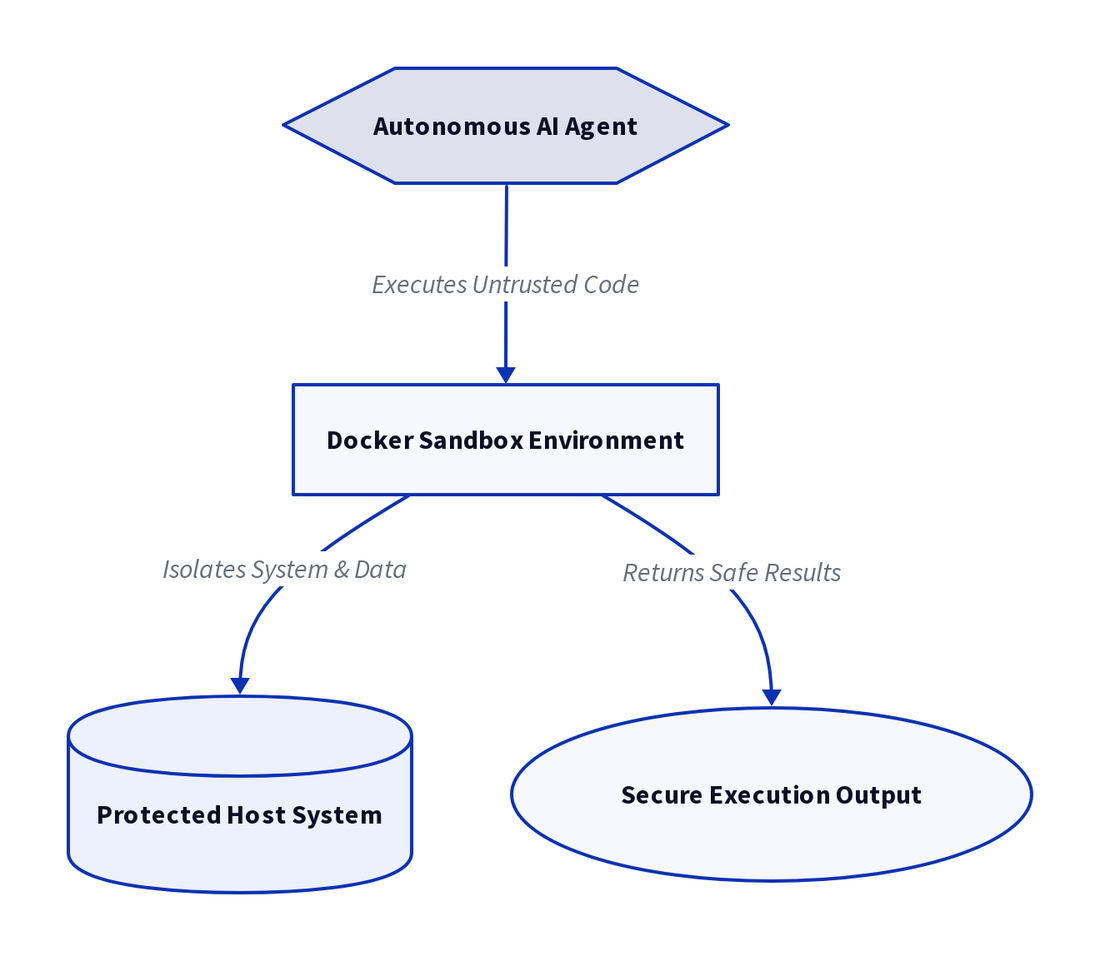
Giving autonomous tools like Claude Code, Copilot CLI, and Codex full access to run unattended usually forces a bad tradeoff between execution speed and host security. If you give an agent permission to install packages and modify local configurations, you put your host filesystem at risk. If you restrict it with constant permission prompts, you ruin its ability to handle long-running tasks. Docker Sandboxes fixes this by locking coding agents inside disposable microVMs with custom filesystem and network boundaries.
This breakdown examines how AI agent sandboxes provide execution freedom without compromising infrastructure control. You will see how microVM isolation enables safe permissive modes, how Docker AI Governance enforces network controls across teams, and how integration with tools like Warp keeps local and cloud environments consistent.
Process diagram — Docker Sandboxes: Secure Local Execution for Autonomous AI Agents
The Security Dilemma of Giving Autonomous AI Agents System Access
Autonomous tools require raw command-line access to manage end-to-end tasks without human intervention. When agents like OpenCode, Kiro, or Gemini CLI operate locally, they need freedom to install software packages, alter environment files, and run scripts. Enforcing continuous permission prompts breaks their execution loop and destroys the bandwidth gains operations leaders expect.
Yet granting unrestricted execution directly on host machines creates severe infrastructure risk. An agent operating with permissive access can alter critical system files, expose local credentials, or corrupt network configurations. System protection cannot depend on probabilistic AI models self-policing their actions. As NanoClaw creator Gavriel Cohen noted:
NanoClaw was built on the principle that you don’t trust agents with security, you build walls around them.
Without isolated AI agent sandboxes, organizations remain stuck between slow, supervised execution and unmanaged operational risk.
How Docker Sandboxes Isolate Agent Workflows via MicroVMs
MicroVM Isolation vs. Standard Container Environments
Standard containers rely on shared host kernel namespaces. While effective for traditional application deployments, an autonomous agent executing raw terminal commands can exploit kernel misconfigurations to escape container boundaries. MicroVM isolation replaces shared kernel reliance with a hardware-level virtualized barrier around each agent runtime. This hard security boundary prevents untrusted code or compromised packages from reaching host processes.
Execution Model
Isolation Boundary
Host Kernel Access
Primary Security Limit
Standard Container
Namespaces / Cgroups
Shared host kernel
Kernel vulnerabilities
MicroVM Sandbox
Running Leading Coding Agents in Unattended Mode
Unattended execution fails when teams must manually approve every command, file edit, or package installation. AI agent sandboxes remove this friction by giving tools full local autonomy inside isolated runtime environments.
Executing Permissive ‘YOLO Mode’ Without System Risk
Autonomous workflows rely on running agents with permissive flags like dangerously-skip-permissions to complete multi-step tasks without stopping for confirmation. Outside an isolated environment, unprompted execution exposes host files and local credentials to accidental corruption or unauthorized modifications.
Enforcing Team Standards with Docker AI Governance
Local sandbox testing proves the core execution model, but scaling autonomous workflows across an engineering team requires centralized policy enforcement. Docker AI Governance allows operations leaders to set mandatory security boundaries across every workstation, preventing configuration drift and unapproved host access without slowing down engineering workflows.
Setting Granular Filesystem, Network, and Credential Controls
Managing execution risks requires explicit security policies enforced across all developer environments. Docker AI Governance provides administrative control across three primary operational boundaries:
Filesystem scoping: Mount only the active project
As autonomous AI agents evolve from simple conversational interfaces into complex code-executing entities, traditional human-in-the-loop permission prompts have become a critical bottleneck and a dangerous security vector. Asking developers to manually approve every bash command, file modification, or network call creates severe alert fatigue, frequently leading users to blindly approve risky operations or prematurely cancel valid agent workflows. Transitioning to dedicated AI agent sandboxes fundamentally redefines this paradigm by enforcing security at the infrastructure layer rather than relying on real-time human intervention. Instead of asking for permission, the execution environment preemptively restricts what the agent can touch through hardware-level and kernel-level boundaries.
By leveraging robust containerization technologies like Docker combined with fine-grained security profiles such as seccomp, modern AI agent sandboxes grant agents unrestricted root privileges inside a strictly isolated, disposable environment. Within a sandbox configured with cgroups to cap memory at 2GB RAM and isolate network namespaces, an agent can autonomously install arbitrary dependencies, execute untrusted scripts, and alter local file systems without threatening the host OS. If an LLM hallucinates a destructive command like `rm -rf /` or attempts an illegal socket connection, the blast radius is entirely confined within the container, rendering the failure harmless and eliminating the need for interactive confirmation prompts.
This structural shift enables true zero-trust execution for local developer environments and enterprise automation alike. Tools like Docker Desktop and gVisor allow platform teams to define static security policies once, such as mounting host directories as read-only or blocking egress traffic to local subnet ranges, allowing agents to run continuously in the background. By swapping fragile user prompts for immutable infrastructure constraints, developers gain sub-second startup times for ephemeral environments where AI agents can operate at full speed without compromising host integrity or requiring constant human supervision.
Ready to find AI opportunities in your business?
Book a Free AI Opportunity Audit. It is a 30-minute call where we map the highest-value automations in your operation.
The Shift from Permission Prompts to Infrastructure Boundaries
Human supervision cannot scale at the speed of modern AI code execution. Attempting to review every file modification, package installation, or terminal command creates an operational bottleneck that neutralizes the efficiency gains of autonomous tools.
Replacing Reactive Permission Prompts with MicroVM Walls
Relying on developers to evaluate safety prompts in real time introduces human error and approval fatigue. MicroVM isolation replaces this reactive loop with hard structural containment, allowing autonomous tools to operate with total local execution freedom inside predefined security boundaries.
As Gavriel Cohen, creator of NanoClaw, observed when evaluating infrastructure-level safety:
you don’t trust agents with security, you build walls around them.
Moving security enforcement from interactive terminal prompts down to hardware-backed microVM walls guarantees host safety without interrupting execution loops.
Enforcement Model
Operational Impact
Security Boundary
Manual Prompts
High latency (constant user prompts)
Weak (vulnerable to human error)
MicroVM Isolation
Zero latency (unattended execution)
Hard (hardware-level kernel isolation)
Preparing Engineering Workflows for Autonomous Agent Fleets
Scaling AI agent sandboxes requires shifting developer environments toward standardized execution containers. Instead of managing security policies on individual machines, organizations must embed hardware boundaries directly into developer CLI environments.
Tooling creators are already integrating these controls into developer workflows. Ben