
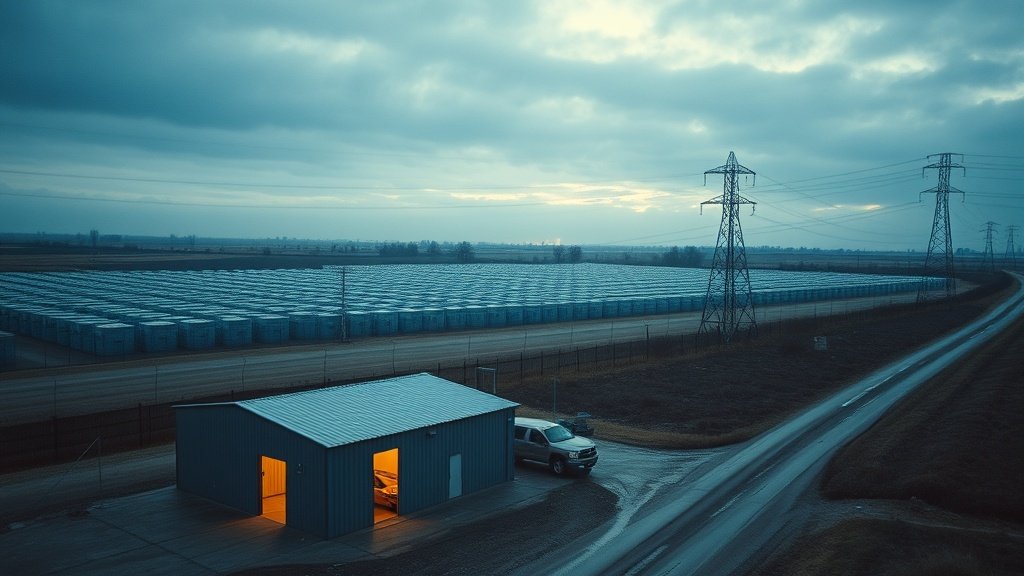
On September 14, President Trump posted that there is a “SICK conspiracy going on against AI and Data Centers, and the only one that is happy about it is China.” Days earlier, the Justice Department warned citizens and noncitizens that furthering the “goals” of a foreign power in “any public activity,” including public demonstrations, could bring criminal liability. Senator Tom Cotton has asked the DOJ to investigate foreign influence in the AI infrastructure buildout. None of this changes your production line, but it does change the politics around every megawatt your AI roadmap assumes.
If your plans depend on hyperscale capacity, land approvals, and grid connections getting easier, you have taken on risk you cannot control. Here is how to decouple your AI program from that fight and still book the ROI.
Your AI Roadmap Is Now a Political Story You Didn’t Write
The escalation continued on September 19, when Trump said that “we will also be looking for BAD, and we can do that, very easily, with our already existing Criminal and Civil Justice System.” Opponents of data centers were cast as “Revolutionaries for a Bad and Evil Cause.” That is the vocabulary now attached to the three letters sitting in your capex request.
Your actual goal is duller and more useful: cut inspection rework, stop three engineers from rekeying deviation reports, give your quality team back a day a week. None of that requires a hyperscale campus or a position on Chinese influence operations.
But the word travels with baggage into your board meeting, your works council, and any local permitting hearing. Separate the theatre from the decisions you control.
What the DOJ Warning and the Trump Posts Actually Say
Brief your leadership from the primary documents, not the coverage. Three separate things happened here, and they do not carry equal weight.
Two are presidential social posts. One is a Justice Department directive circulated as a downloadable PDF. One is a letter from a senator. Only the DOJ document has any procedural teeth, and even that names nobody.
The notification requirement and who it plausibly touches
The DOJ instruction covers “citizens and noncitizens” alike. Anyone furthering the “goals” of a foreign power in “any public activity,” explicitly including “public demonstrations,” is told to formally notify the government or face arrest and prosecution.
Read the word “goals” twice. Not instructions, not funding, not coordination. On a plain reading that scope could reach a resident objecting to a substation at a zoning hearing, a utility commission intervenor arguing about ratepayer costs, or a local group asking about water draw. Worth stating clearly for your leadership: in Ken Klippenstein’s reporting, no specific protest is identified, no organisation is named, and no evidence is cited. The document describes a category, not a case.
How Congress amplified the foreign-influence frame
The framing predates September. In June, Senate Intelligence Committee chairman Tom Cotton wrote to then-acting Attorney General Todd Blanche requesting an investigation into “foreign influence efforts targeting the buildout of American AI infrastructure,” describing a network of foreign actors led by the Chinese Communist Party.
Trump’s own explanation of the opposition runs along the same line:
The only reason the AI/Data Center outburst is happening is because the United States is leading, by a lot, every other country.
That is the whole record as it stands. A legal notification requirement with undefined edges, a set of posts, and a congressional letter. What it produces is not a rule you can comply with but a climate in which ordinary local objections to a site arrive pre-labelled as hostile activity. That climate is what your infrastructure decisions now have to survive.
Why a Fight About Data Centers Lands on Your Shop Floor
Energy, permitting, and the cost of being near the buildout
Hyperscale capacity competes with you for the same two scarce things: electricity and permits. Where a region is courting a large compute campus, interconnection queues get longer and industrial power contracts get renegotiated on worse terms. You do not need to host a data center to pay for one being built nearby.
Permitting is the slower burn. Once local opposition organises around one project, planning boards get cautious about every industrial application that follows, including your new line, your extra substation, your expanded footprint. Budget more calendar time, not more money, and stop assuming approvals move at the pace they did three years ago.
For European manufacturers there is a second-order version of this. US infrastructure politics feeds into vendor pricing, which cloud regions get capacity first, and how confidently your provider can answer data residency questions. Those answers already sit on your risk register. They are now moving targets.
Internal resistance when AI becomes a loyalty test
Your quality engineers read the same feeds you do. When the President writes that people who say “Data Centers are bad for your neighborhood” are “Revolutionaries for a Bad and Evil Cause,” the word AI stops being a tool category and becomes a position you are expected to hold.
That is corrosive to adoption. A line supervisor who is quietly sceptical about a vision inspection pilot now has cover to frame that scepticism as principle rather than a practical objection you could actually address. You lose the useful feedback and keep the resistance.
Fix it by refusing the frame entirely. Never brief a deployment as an AI project. Brief it as reducing false-reject rates on station four, or cutting the time between a deviation being logged and being closed. Name the metric, name the owner, name the date. People argue about AI. They do not argue much about getting Friday afternoons back.

Decoupling Your AI Programme From Hyperscale Infrastructure Politics
The work that pays back inside a year does not need a gigawatt campus. Defect classification on the vision hardware already bolted to your line, non-conformance triage, extraction from supplier certificates and CoAs, first-draft CAPA writing. These are small-model jobs. They run on a workstation with a single GPU, or on an industrial PC at the cell.
Workloads that run on hardware you already control
Start by sorting your backlog by where the data lives. If the input is a batch record, an inspection image, or a PDF from a supplier, the model can sit next to the data. Fine-tuned open-weight models in the 7B to 14B range handle document extraction and classification well enough for production, and you are not paying per token or waiting on a region.
Keep frontier API models for what they are genuinely better at: drafting, summarising long investigation histories, ad hoc analysis. Treat those as a convenience layer, not a dependency. If that layer disappeared for a month, the on-premise work should still run. Design it so that is true, then test it by turning the API off for a day.
Procurement terms that survive a policy shock
Buy compute outright where you can. A capitalised GPU server has no political exposure and no renewal negotiation. Where you do use cloud, refuse single-region commitments and insist on data portability clauses with a defined export format, not a vendor’s word. Multi-year reserved capacity in one geography is exactly the bet you should not be making right now.
Write the exit into the contract. Specify model weights or fine-tune artefacts you retain, a maximum notice period, and who owns the prompt and evaluation sets. Then hold the ROI case to something a headline cannot touch: a quality team recovering 12 to 15 hours a week on documentation is a line item you can audit. Trump can call the critics “Traitors” all he likes. Your hours back are still your hours back.
Ready to find AI opportunities in your business?
Book a Free AI Opportunity Audit. It is a 30-minute call where we map the highest-value automations in your operation.
Building an AI Programme That Outlasts the Next News Cycle
The foreign-agent framing tells you something that will outlive the current occupant of the White House. AI stopped being a technology decision and became a political one. Administrations change, the vocabulary changes, and the pressure keeps arriving from a different direction each time.
So stop defending AI as a category. Nobody on your board can win that argument, and the people making it loudest are not talking about non-conformance triage. Defend specific work that produced specific results, and the abstract fight stays somebody else’s problem.
Metrics that make your AI work politically unarguable
Publish internal numbers monthly, in the same format you use for OEE or scrap. Hours returned to named teams. Scrap reduced on named lines. Audit findings closed and how long closure took. A quality manager who can show that deviation review dropped from four days to one has a fact, and facts survive news cycles that opinions do not.
The discipline that makes this work is baselining. Measure the process for four to six weeks before anything is deployed, or you will spend the next year arguing about whether the improvement was real. Most programmes skip this and then cannot prove anything. It is the cheapest insurance available and almost nobody buys it.
Keep the reporting boring. No model names, no vendor logos, no claims about transformation. A table with a before column and an after column does more for your budget than any narrative.
- Name three processes: Pick the three you will automate in the next two quarters. Not ten. Three, with an owner on each.
- Baseline before you build: Cycle time, error rate, headcount hours. Written down, dated, signed off by the process owner.
- Keep infrastructure boring and reversible: Choose deployments you can move, shrink, or switch off in a quarter without a renegotiation.
Do those three things and the debate about AI data centers becomes background noise rather than a threat to your roadmap.
Source: kenklippenstein.com