
AI Agents Playbook: How Enterprises Are Winning on Margin
What KPMG Found: Agents Are Moving the Margin Needle
KPMG’s latest research on enterprise AI adoption delivers a clear signal: organizations deploying AI agents are not just automating tasks — they are compressing costs and recovering margin at a pace that traditional process improvement cannot match. Across manufacturing, logistics, and quality-intensive industries, KPMG found that agentic AI is generating measurable efficiency gains in the range of 20–40% in targeted workflows, with some early adopters reporting full ROI within six months of deployment.
This is not boardroom theater. The findings point to a structural shift in how competitive operations are built. Companies that move now are building margin advantages that will be difficult to close later. Companies that wait are funding their competitors’ next capital investment.
For quality managers and operations leaders in manufacturing, the question is no longer whether AI agents are relevant. It is where to deploy them first.
What an AI Agent Actually Does in an Operations Context
Strip away the hype, and an AI agent is straightforward: it is software that perceives inputs, reasons about them, takes action, and learns from outcomes — without a human in the loop for every step.
In a manufacturing context, this plays out in practical terms. Consider a quality inspection line. A traditional system flags a defect and stops. An AI agent flags the defect, cross-references it against historical batch data, identifies a likely root cause, logs a corrective action request, and notifies the relevant supplier — all before the next part reaches the inspector. The human reviews a summary and approves. The cycle time for that entire sequence drops from hours to minutes.
Or consider a compliance monitoring scenario. An agent continuously scans production logs, certifications, and supplier documentation against regulatory requirements. When a gap appears, it drafts a corrective notice and escalates based on risk level. Your compliance team stops chasing paperwork and starts managing exceptions.
This is the core value of enterprise AI agents: they collapse the distance between detecting a problem and resolving it.

The Four Agent Use Cases Delivering the Fastest ROI
Based on KPMG’s playbook and deployment patterns we see across manufacturing clients, these four areas are where the AI agent playbook is generating the fastest returns:
1. Automated Visual Inspection
Computer vision agents monitor production lines in real time, identifying defects with greater consistency than manual inspection. Expected outcomes include a 30–50% reduction in escape defects and a significant drop in inspection labor costs. The speed advantage also means defects are caught earlier in the process, reducing scrap and rework costs downstream.
2. Supplier Quality and Compliance Monitoring
Agents continuously audit incoming material certifications, delivery performance data, and compliance documentation. They flag deviations, generate non-conformance reports, and track corrective action timelines automatically. Operations teams that have deployed this report reclaiming 15–20 hours per week in manual supplier management work per quality engineer.
3. Production Anomaly Detection and Response
Agents monitor equipment telemetry and process parameters, identifying drift before it becomes a quality failure or unplanned downtime event. Early agentic AI manufacturing deployments in this category show maintenance cost reductions of 10–25% and measurable improvements in OEE (Overall Equipment Effectiveness).
4. Regulatory and Documentation Workflows
In heavily regulated environments — automotive, aerospace, food manufacturing — documentation burden is enormous. Agents that auto-populate quality records, cross-check regulatory requirements, and generate audit-ready reports are delivering 40–60% reductions in documentation time. This alone frees senior quality staff to focus on engineering work rather than administrative overhead.
The AI agent playbook works because each of these use cases targets a high-frequency, rules-based workflow where human bandwidth is being consumed by repetitive decisions — exactly the conditions where agents deliver outsized value.
How to Start: A Practical Agent Deployment Roadmap
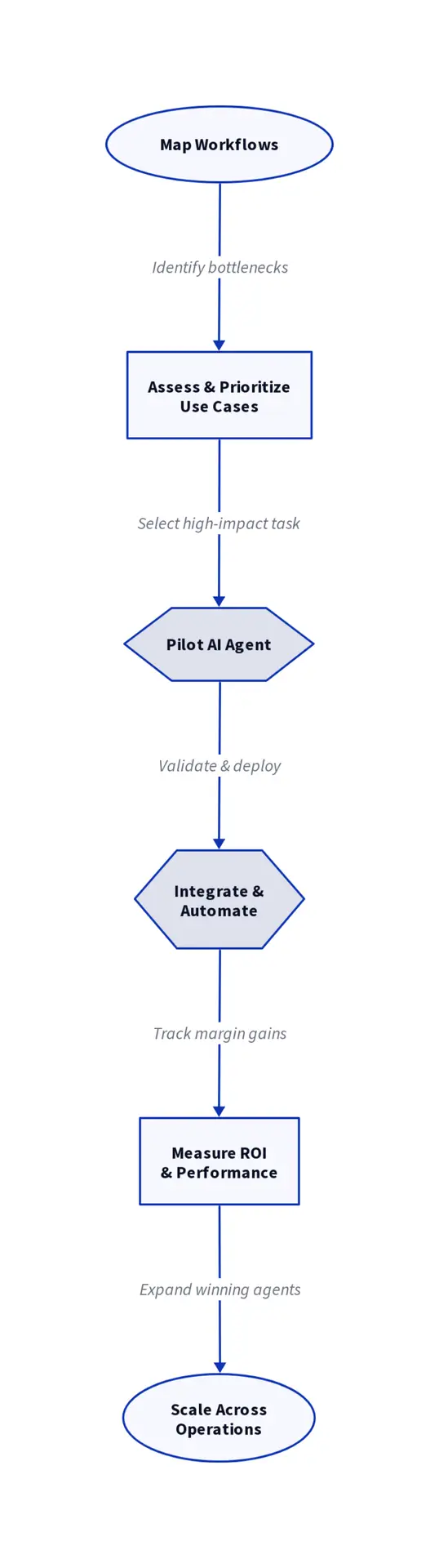
The biggest mistake operations leaders make is trying to deploy AI agents at scale before they understand where the real value sits. Here is a sequenced approach that works in practice:
- Step 1 — Map your highest-friction workflows. Identify three to five processes where your team spends significant time on repetitive, rules-based decisions. Quality holds, supplier follow-ups, and compliance checks are common starting points. Document the current time cost and error rate for each.
- Step 2 — Prioritize by data readiness. AI agents run on data. Shortlist the workflows where you already have structured, accessible data — production logs, inspection records, supplier portals. This is where you can move fastest without a large IT lift.
- Step 3 — Run a contained pilot. Select one workflow. Define a clear success metric — reduction in cycle time, defect escape rate, documentation hours. Deploy the agent in a controlled environment for 60–90 days. Measure rigorously.
- Step 4 — Document the ROI case. Quantify what the pilot delivered. This becomes the internal business case for scaling and, importantly, builds confidence in the technology across your team.
- Step 5 — Scale deliberately. Apply learnings from the pilot and expand to adjacent workflows. Each successive deployment moves faster because your team now has a working model for agent integration.
This roadmap is designed for operations teams that do not have a large data science department. The AI agent playbook does not require one. It requires clear workflow definition, clean data, and a willingness to measure what matters.
Ready to find AI opportunities in your business?
Book a Free AI Opportunity Audit — a 30-minute call where we map the highest-value automations in your operation.
Conclusion
KPMG’s findings confirm what leading manufacturers are already proving on the floor: the AI agent playbook is not a future strategy — it is a present-tense margin lever. Quality managers and operations leaders who deploy agents in inspection, compliance, anomaly detection, and documentation workflows are compressing costs and freeing their best people for higher-value work.
The window to build a meaningful operational lead is open now. Waiting another year does not make the implementation easier — it just transfers the advantage to a competitor who acted sooner.
If you want to know exactly where AI agents can deliver the fastest wins in your specific operation, book a Free AI Opportunity Audit with FalcoX AI. In 30 minutes, we will map your highest-value automation opportunities and give you a clear starting point — no commitment required.