
Every time your team deploys a new AI agent, they likely build a separate retrieval pipeline with custom chunks and embeddings. As technologist Shuhua Xu points out, treating context as an isolated patch for individual applications quickly breaks down. When your core operational workflows contradict each other across Jira tickets, SOP documents, and CRM records, different agents develop conflicting views of your business while your team repeatedly rebuilds the same data infrastructure.
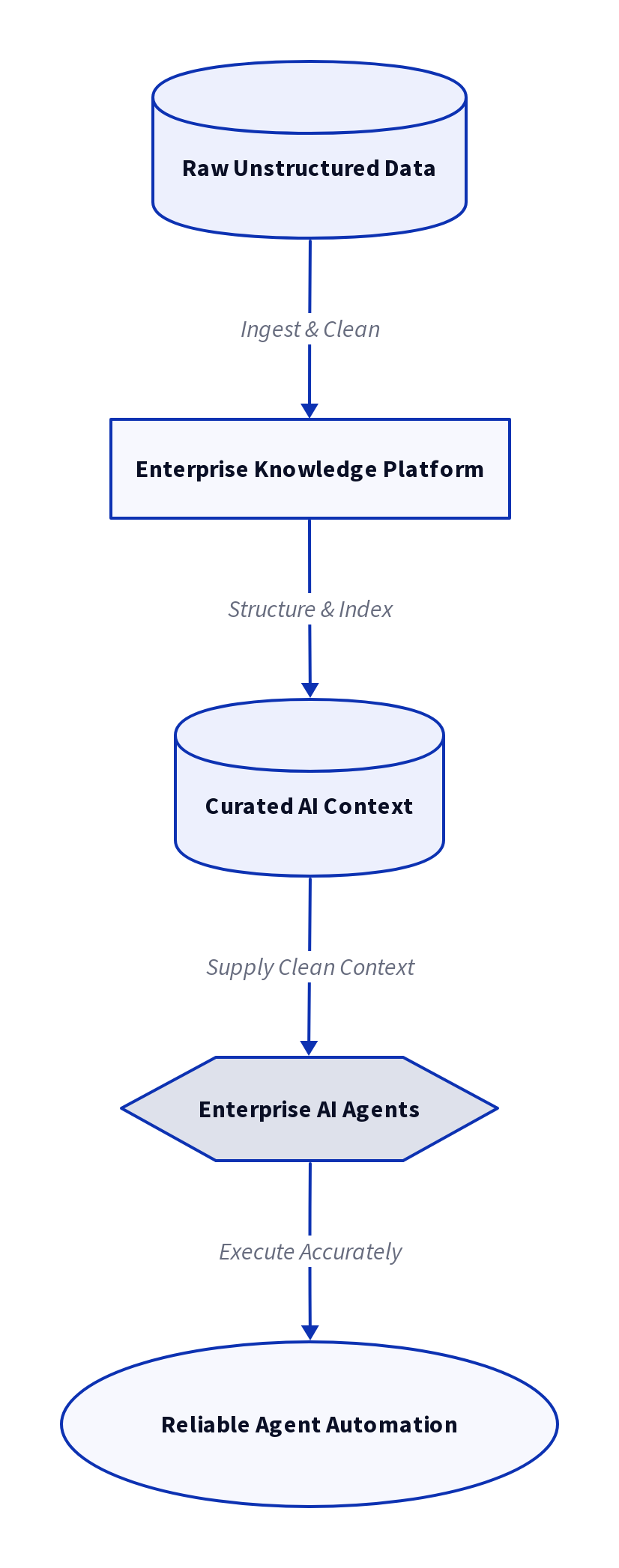
Patching context at the application layer will not fix underlying enterprise AI data quality. To run reliable automated operations, you must transition from ad hoc context engineering to a unified enterprise knowledge platform. This guide outlines the practical steps to audit messy document stores, cut redundant pipelines, and give your agents a reliable, single source of operational truth.
The Hidden Failure Mode of Enterprise AI: Siloed Context Pipelines
Point-solution RAG architectures scale poorly across plant operations. A quality team builds a copilot to query engineering change orders, while maintenance engineers train an agent on equipment manuals. Both teams extract data from overlapping PDFs, Jira tickets, and legacy ERP records, but each maintains a separate retrieved context pipeline.
When operational specifications update on the factory floor, these disconnected pipelines desynchronize. The maintenance agent runs on cached embeddings reflecting last quarter’s tolerance thresholds, while the quality agent reads updated specifications. The result is silent operational drift, where two autonomous agents issue conflicting instructions for the same production line.
This architectural fragmentation undermines overall enterprise AI data quality. Instead of solving knowledge management once at the platform level, engineering teams spend hundreds of hours maintaining duplicate parsing scripts and out-of-date vector indexes.
Three Architectural Bottlenecks Breaking Your Enterprise AI Agents
Inconsistent enterprise definitions creating conflicting agent outputs
Enterprise knowledge lives distributed across independent systems with conflicting schemas, varying metadata, and unaligned business definitions. A single product specification, asset identifier, or quality threshold often carries contradictory values across CRM records, Jira tickets, source code repositories, and static PDF manuals. Extracting this raw data directly into a retrieved context pipeline transfers those contradictions straight into runtime models.
Standard context engineering cannot resolve discrepancies hidden within raw enterprise files. When underlying definitions conflict across backend databases, autonomous agents develop divergent understandings of standard
Enterprise Knowledge Platforms: Transitioning From App Context to Shared Assets
Decoupling document ingestion from individual agent applications
Every AI agent currently deployed in your organization is likely pulling data from the same source documents, yet each has its own ingestion pipeline. This duplication is not just inefficient, it creates inconsistencies. Instead of letting each application define its own way of processing knowledge, you need a centralized ingestion layer that handles document parsing, chunking, and embedding generation once. This approach ensures that all agents work from the same raw data, reducing errors and saving engineering time.
Creating single-source-of-truth representations for business operations
Enterprise AI systems can’t function reliably if they’re trained on conflicting definitions of the same business concept. A unified knowledge platform ensures that every product specification, quality threshold, or operational rule is represented consistently across the organization. This is not just about data quality, it’s about ensuring that AI agents have a shared understanding of the business context they’re operating within. As Shuhua Xu notes, extracting raw data into context pipelines transfers contradictions directly into AI outputs.
Establishing unified knowledge governance across operations and quality teams
Without a centralized knowledge governance model, operations and quality teams will continue to maintain siloed context pipelines. A unified platform enables both teams to access and update knowledge in a single place, ensuring that changes in SOPs, equipment manuals, or quality standards are reflected across all AI applications. This eliminates the need for repeated data processing and ensures that every AI agent operates on the most up-to-date and accurate information available.
Practical Steps for Operations Leaders to Clean the Knowledge Layer
Audit existing SOPs, engineering tickets, and metadata for conflicting terms
Start by mapping out where your operational knowledge lives, SOPs, engineering tickets, and metadata across systems. Identify where the same asset or process is described differently in CRM, Jira, or source code. This isn’t just about data quality, it’s about ensuring your AI agents don’t inherit contradictions. Shuhua Xu notes that extracting raw data without resolving inconsistencies transfers them directly into agent outputs. Use this audit to create a single source of truth for definitions and processes.
Consolidate fragmented vector indexes into a standardized knowledge layer
Every AI agent currently pulling from the same documents but maintaining its own embeddings is a waste of resources and a risk to consistency. Consolidate these into a unified knowledge layer that handles ingestion, chunking, and embedding generation once. This eliminates redundant pipelines and ensures all agents access the same representations. A centralized layer also makes it easier to apply updates, governance, and quality checks across the board.
Implement automated change triggers to prevent out-of-date agent responses
As enterprise knowledge evolves, your AI systems must evolve with it. Set up automated triggers that detect changes in source documents, metadata, or system schemas and propagate updates through the knowledge layer. This ensures that agent responses are always based on the latest information, not outdated embeddings or cached data. Without this, your AI systems will start operating on stale knowledge, leading to unreliable automation and poor quality outcomes.
Ready to find AI opportunities in your business?
Book a Free AI Opportunity Audit. It is a 30-minute call where we map the highest-value automations in your operation.
The Future of AI Automation Depends on Knowledge Governance First
Prompt engineering and runtime context patching only mask underlying data rot. High-performing operational leaders treat business knowledge as shared infrastructure rather than a temporary band-aid for individual applications. Building unified knowledge platforms eliminates redundant engineering, stabilizes agent execution, and protects long-term investments in factory automation.
Reallocating budget from prompt engineering to knowledge infrastructure
Shift capital spent on custom prompt wrappers and brittle retrieval pipelines toward central data architecture. Paying software developers to endlessly tune system prompts for broken context retrieval steps drains operational budgets without fixing root-cause failures. Instead, invest in ingestion systems that parse, clean, and publish single-source enterprise assets once for every downstream application.
As technologist Shuhua Xu emphasizes, enterprise data platforms previously solved this issue for structured records by managing data once and serving it everywhere. Enterprise AI requires that same structural discipline applied to unstructured knowledge platforms.
| Investment Focus | Prompt Engineering Approach | Knowledge Platform Approach |
|---|---|---|
| Operational Value | Isolated application patch | Shared enterprise asset |
| Engineering Effort | Rebuilt for every agent | Built once, published everywhere |
| Scaling Cost | Linear cost per bot | Decreasing marginal cost |
Measuring agent success through reduced defect rates and higher document hygiene
Stop tracking surface-level engagement metrics like total query volume or chat response times. Real financial returns depend on enterprise AI data quality, which directly impacts factory throughput, scrap rates, and regulatory compliance. Evaluate your AI deployments using direct operational indicators:
- Defect reduction: Measure the decline in operational errors and assembly rework caused by agents pulling outdated engineering specifications.
- Document hygiene: Track the percentage of redundant manuals, deprecated Jira tickets, and contradictory code records purged prior to platform indexing.
- Output consistency: Monitor cross-agent reliability when separate maintenance and quality tools query the exact same underlying asset simultaneously.
When you enforce strict governance at the knowledge layer, your autonomous agents stop generating conflicting instructions and begin delivering predictable, audit-ready operational performance.
Source: venturebeat.com