Your plant operations do not need a multi-million-euro hardware overhaul to run advanced automation. A developer recently built ClawDOS, an AI coding agent that runs on an IBM PC XT from 1983 equipped with a 4.77 MHz processor and 640K of RAM. Using a lightweight 176 KB executable, the system communicates with Claude to write, compile, and execute code directly on four-decade-old hardware.
If an AI coding agent can run Turbo C builds on an ancient 8088 chip, your legacy PLCs, SCADA systems, and industrial controllers can work with modern AI today. This article breaks down the practical lessons from ClawDOS, showing you how to bridge AI agents with your existing infrastructure to eliminate manual work and improve quality without replacing your core machines.
The Legacy Hardware Myth Hindering Enterprise AI Adoption
Most industrial executives believe that adopting modern automation requires tearing out legacy PLCs and SCADA networks. Capital expenditure proposals for full infrastructure refreshes routinely stall digital transformation before it begins. The underlying assumption is simple: if a machine cannot handle modern encryption or heavy local compute, it cannot participate in modern workflows.
The architecture behind ClawDOS dismantles this myth through offloading. The system delegates network-heavy requirements like TLS to a lightweight bridge PC, allowing the primary executable to run natively on vintage host hardware. Industrial leaders can apply this exact edge pattern on the factory floor today.
Integrating AI coding agents into legacy operations does not demand multi-million-euro hardware replacements. By placing an off-board proxy between aging shop floor controllers and modern cloud APIs, enterprises automate complex tasks while keeping reliable physical assets fully intact.

Inside ClawDOS: Running Claude on an 8088 Processor
The 176 KB Native Harness Architecture
Creator Ricapar engineered HARNESS.EXE, a tiny binary that operates natively under MS-DOS on an original IBM PC 5160 powered by an 8088 chip running at 4.77 MHz. Instead of running heavy abstraction layers or modern network dependencies, the executable directly handles local files, formats raw API requests, and parses incoming JSON text streams line by line. This lean footprint provides direct programmatic control over ancient hardware resources.
To operate within strict 640 KB system memory limits, the system employs aggressive memory management.
Buffer management splits incoming JSON payloads into chunked buffers, passing code execution commands directly to the MS-DOS command interpreter or saving them as batch files. By stripping away heavy runtime environments and thick operating system layers, the agent interacts directly with local disk sectors and system calls. AI coding agents do not need gigabytes of RAM or multithreaded processors to issue precise, contextual instructions to a machine. They only need a deterministic communication channel and a minimal interpreter capable of translating structured text into native system commands.
This execution model carries immediate practical implications for legacy industrial operations.
Autonomous Execution and Context Retention Under Constraints
State Saving and Turbo C Compilation Loops
Resource-constrained environments cannot maintain active agent logic and heavy compilation tools in memory simultaneously. ClawDOS solves this by writing its process state directly to local storage. When compilation begins, the program saves conversation history to disk and exits memory, granting Turbo C roughly 450 KB of free memory to compile and link binaries.
Once Turbo C finishes, the native binary reloads into memory, reads the build log, and resumes execution. This disk-swapping mechanism permits complex tool calls on minimal infrastructure without memory crashes.
This compilation loop demonstrates how AI coding agents can operate inside environments previously written off as completely obsolete. Manufacturing lines, energy grids, and maritime logistics facilities still rely on decades-old hardware running DOS, early Windows releases, or custom real-time operating systems. Replacing these physical controllers costs millions of dollars and introduces operational risks that facility managers actively avoid. ClawDOS shows that instead of ripping out vintage infrastructure, teams can deploy AI coding agents that adapt to existing memory limits and vintage toolchains.
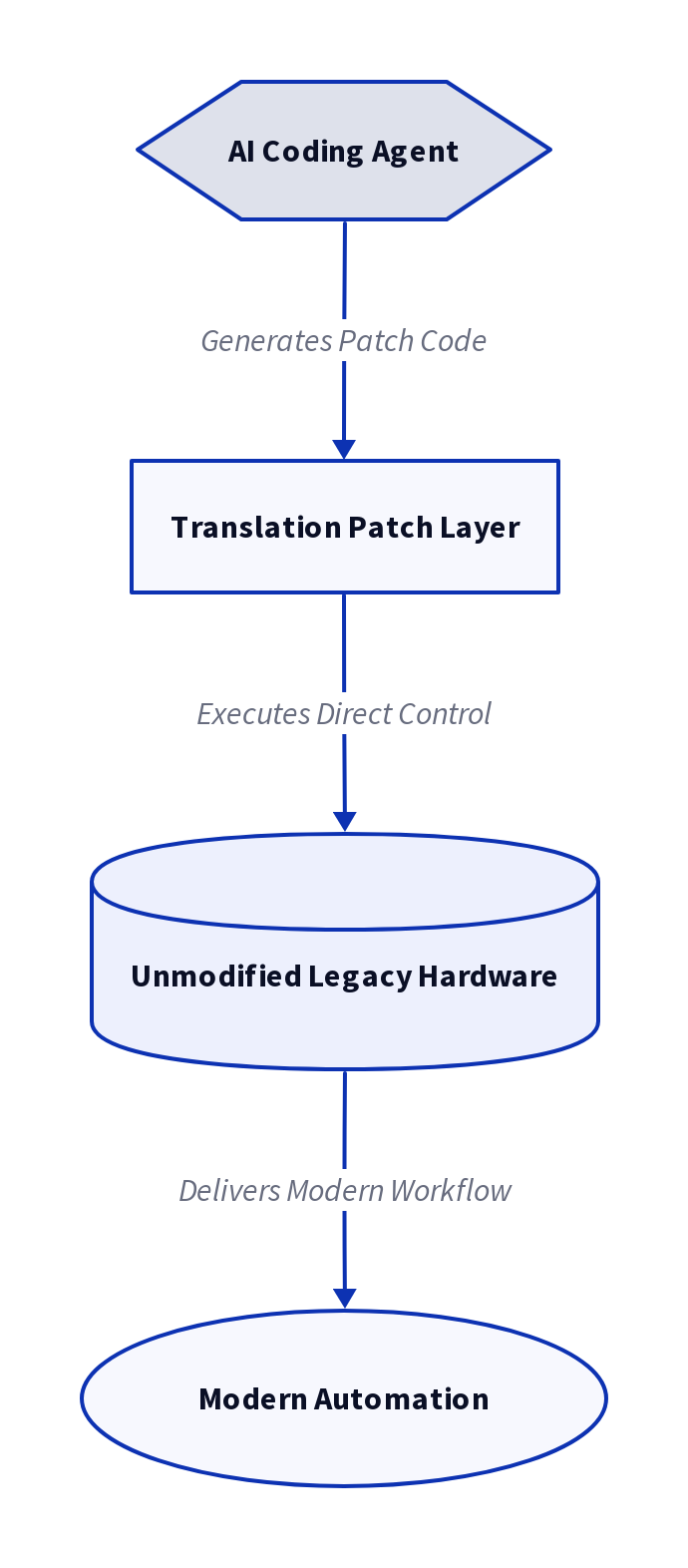
By decoupling the agent’s heavy reasoning engine from the target machine’s execution environment, this architecture bridges modern neural networks with legacy code bases. The AI coding agents process file structures and reason about logic off-device or via lightweight proxy calls. They output plain, standard C source code directly into the local directory, relying on simple disk writes to hand over control to the local compiler. The legacy operating system sees only a standard build script, completely unaware that a modern model wrote the updates.
Industrial operations gain the ability to refactor aging codebases, patch decades-old security flaws, and debug proprietary C libraries directly on the target systems. You do not need modern servers or gigabytes of system memory on the factory floor to run complex programming workflows. If a machine can write a text file to a local drive and invoke a native compiler, it can execute an agent loop.

Translating Retro Hacks to Industrial AI Automation
Decoupling Compute Engine from Intelligence
Plant floor equipment runs deterministic loops where safety and predictable cycle times dominate. Attempting to embed heavy software models directly into operational technology networks creates unnecessary risk and requires expensive hardware overhauls. The underlying design of ClawDOS proves that legacy hardware only needs to format raw local data and accept structured instructions back from an external model.
An edge gateway acts as the mid-tier processing bridge. It handles protocol translation, request encryption, and state verification while leaving PLCs to perform their primary function: executing control loops.
By shifting the generative workload away from the plant floor, AI coding agents can safely inspect, refactor, and update vintage codebases without touching live machine execution. A legacy controller running decades-old assembly or ladder logic does not need native memory to parse complex token trees. Instead, AI coding agents ingest exported register dumps or legacy source files, analyze performance bottlenecks off-site, and compile optimized routines into format-compliant instructions that old hardware understands natively.
This architecture removes the financial barrier that has kept legacy facilities stuck in static operational modes. Factory managers often assume that implementing adaptive logic or self-healing software requires multi-million dollar rip-and-replace initiatives. ClawDOS demonstrates the opposite. By leaving the physical controllers in place and wrapping them with intelligent software layers that communicate over basic serial or legacy Ethernet protocols, facilities can deploy advanced features without replacing a single physical terminal.
The security and stability of this model rely on clear separation. AI coding agents operate as asynchronous advisory tools rather than synchronous runtime controllers. They analyze telemetry patterns, spot efficiency losses, write updated control scripts, and validate those changes within simulated sandboxes before any code reaches the physical machinery.
Once validated, the gateway converts the new logic into standard PLC instructions during scheduled maintenance windows. The legacy machine executes its standard scan cycle without disruption, running code optimized by an agent that sits entirely outside the physical chassis.
Ready to find AI opportunities in your business?
Book a Free AI Opportunity Audit. It is a 30-minute call where we map the highest-value automations in your operation.
Architecting Zero-Fluff AI Integration for Older Operating Systems
Modernizing industrial operations does not require tearing out reliable plant machinery. ClawDOS proves that intelligent control loops function effectively over minimal infrastructure. When a 1980s system can process an AI coding agent request in 64 seconds, with 26 of those seconds spent compiling and linking binaries locally, operational networks can run automated logic without hardware overhauls.
Engineering executives must evaluate AI readiness based on input-output capability rather than local clock speed. Replacing functional equipment simply to gain native cloud connectivity creates unnecessary financial risk and extended factory downtime. Modernizing legacy systems requires treating old controllers as execution endpoints rather than self-contained computing hubs.
| Operational Requirement | Full Infrastructure Overhaul | Thin-Client Agent Architecture |
|---|---|---|
| Network Security | Replace hardware for native TLS support | Edge bridge handles encryption externally |
| Memory Management | Install multi-gigabyte industrial PCs | Process state saved to local storage during execution |
| Interface Support | Standardize on proprietary cloud networks | Adapt existing storage media like SD card emulators |
| Financial Impact | Six-figure CapEx hardware investment | Targeted software layer on existing assets |
Implementing this architecture requires three practical steps for plant teams. First, map your terminal interfaces and set strict file system access boundaries for local execution. Second, deploy a low-cost edge proxy to manage secure networking and API message parsing. Third, configure the local logic to save process state to disk and exit memory whenever heavy compiling tools or subroutines run.
This approach shifts digital transformation from a multi-year capital proposal into an immediate operational improvement. Decoupling modern intelligence from physical hardware constraints allows plant managers to eliminate manual data entry, automate quality logging, and boost asset throughput today. You gain the capabilities of modern software while leaving underlying machinery untouched.
Source: ricapar.net