

Chat-based AI coding agents promised to end manual software development, but writing endless paragraphs of English to nudge LLMs in a chat window creates its own fatigue. You lose tracking of human intent because prompts are discarded, tokens are wasted re-explaining context, and control over code quality slips away.
An experimental editor called Huzzah offers a cleaner alternative. By replacing transient English prompts with persistent, declarative pseudocode, Huzzah anchors AI generation directly inside version-controlled files. This article breaks down how this new AI coding paradigm works, why moving away from conversational prompts restores control over your codebase, and what this efficiency shift means for engineering throughput.
The Fatigue of AI-Driven Code Generation
The honeymoon period of delegating software builds to conversational agents ends when engineers spend entire afternoons writing paragraphs of explanatory text. Natural language evolved for social communication, meaning the average spoken or written sentence is scarce in real technical information. Directing application changes through iterative dialogue forces teams into a cumbersome loop of restating context and hoping the model interprets the intent correctly.
This communication barrier creates real operational drag. Quality managers and technical leaders need predictable, verifiable logic in their codebases. When developers spend their hours negotiating with chat interfaces, cognitive bandwidth shifts away from high-level architecture toward prompt troubleshooting. Avoiding manual syntax should eliminate friction, not introduce a new layer of conversational exhaustion.
What Huzzah Actually Is
Huzzah is an experimental code editor built to replace conversational chat interfaces with code-native files. Instead of prompting AI agents in longform English prose, developers define application logic directly inside source files to establish a more controlled AI coding paradigm across engineering teams.
Pseudocode as the primary input format
Traditional conversational tools force software engineers to write verbose instructions for simple operations. Huzzah changes this input format by using structured pseudocode stored in dedicated files like fizz_buzz.hz. Developers write concise logical statements, such as
How Huzzah Works in Practice
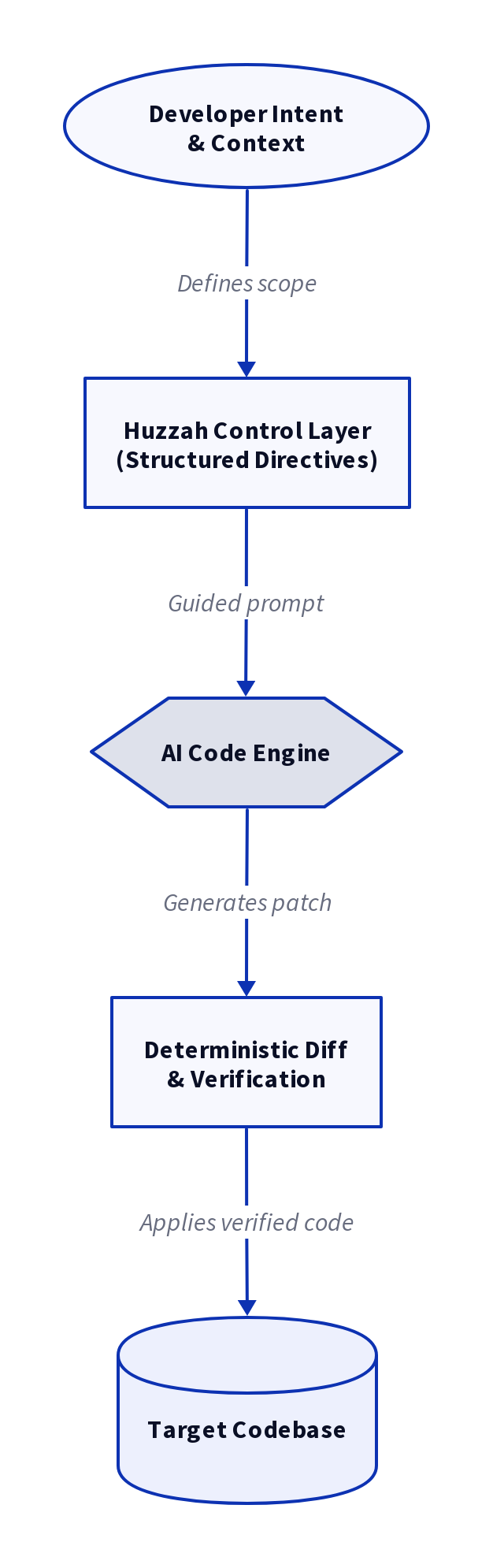
Huzzah replaces conversational chat windows with a structured, file-based workflow that aligns with standard software engineering practices. The system translates compact, declarative pseudocode into production-ready software through three concrete operational steps.
Creating a new file in Huzzah format
Developers initiate a build by creating a dedicated specification file using the .hz extension. Inside this file, you write terse pseudocode outlining variables, boundaries, and logic. A routine like fizz_buzz() requires only five lines to define loop
A Head-to-Head Comparison: Huzzah vs. Traditional Coding Agents
Comparing chat-based tools against file-native editors highlights distinct operational trade-offs between speed, code governance, and token consumption across the software development lifecycle.
| Operational Metric | Traditional Coding Agents | Huzzah Editor |
|---|---|---|
| Input Format | Imperative longform English | Declarative pseudocode |