
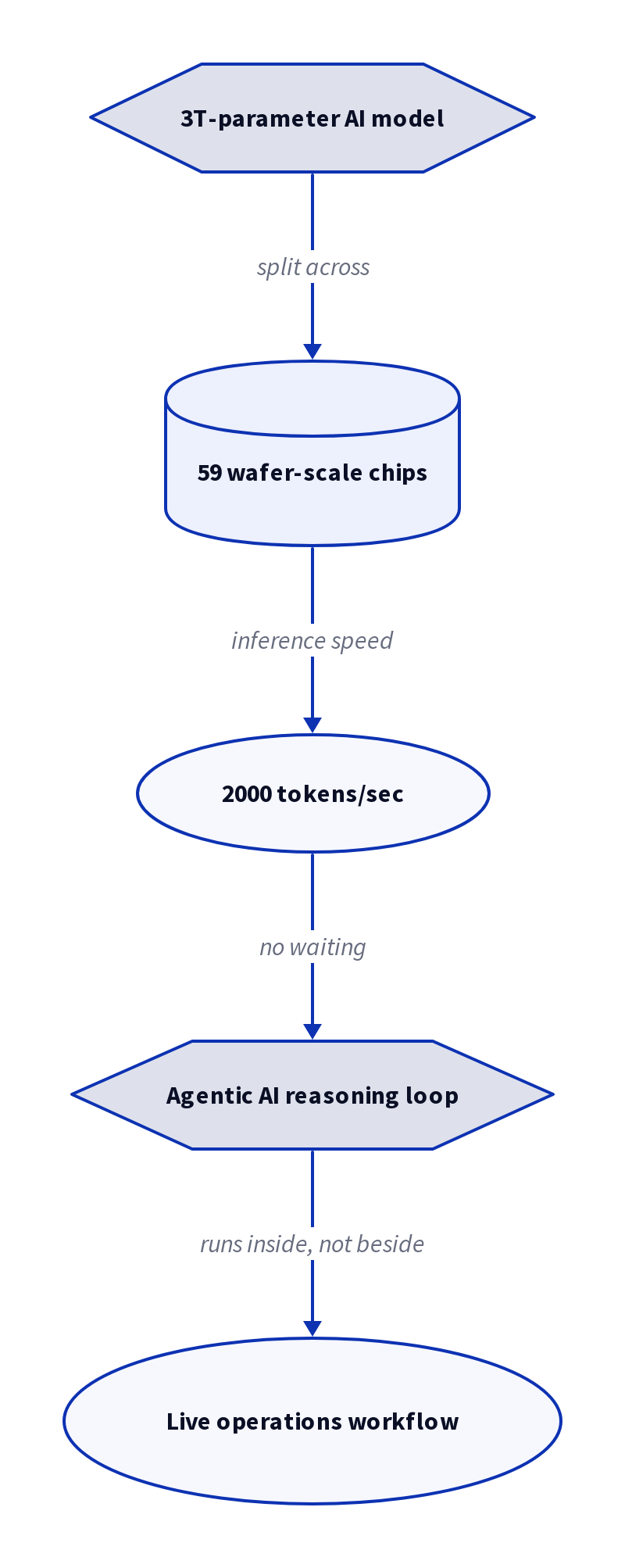
Most AI tools in manufacturing sit beside the workflow, not inside it. An operator asks a question, waits eight seconds for a response, then goes back to the MES to actually do something. That latency is why AI agents stay stuck in pilot projects. Cerebras just changed the arithmetic. Engineer Sarah Chieng detailed how her team splits Kimi K3, a 3-trillion-parameter open source model, across 59 WSE-3T wafers to run at 1000-2000+ tokens per second, with only activations moving between chips at roughly 2 microseconds per hop.
At that speed, an agent can read a deviation report, cross-check the batch record, and draft a CAPA before your quality engineer finishes reading the alert. Below, we break down what trillion-parameter AI models at this throughput actually change in operations, and where the ROI shows up first.
Your AI Agent Is Smart Enough. It’s Just Too Slow to Use.
Capability stopped being the constraint a while ago. Kimi K3 scores 88.3% on Terminal-Bench 2.1 against GPT-5.6 Sol’s 88.8%, and beats it on BrowseComp at 91.2% versus 90.4%. An open source model now reasons at frontier level on coding and agentic tasks. That is not the problem.
The problem shows up on the floor. A quality engineer asks an agent to trace a nonconformance across three batch records and waits. Forty seconds later the answer arrives, and by then the engineer has already opened the files manually. Do that twice and the tool is dead, no matter how good the reasoning was.
Operations work tolerates about two seconds of thinking before people route around the system. Everything slower becomes a report you read later, not a decision you make now.

What Cerebras Actually Announced: 3 Trillion Parameters Across 59 Wafers
The post from Cerebras walks through the deployment math on a single model, and the numbers are specific enough to check. Kimi K3 has 93 layers total: 69 linear-attention layers and 24 dense layers. Cerebras runs it at 1000-2000+ tokens per second.
No GPU cluster, no weight streaming from off-chip memory, no batching tricks to hide latency. Just a pipeline of wafers passing activations between each other.
Why the memory math forces a multi-wafer layout
A single WSE-3T wafer holds 44 GB of on-chip SRAM. At 4-bit weight quantization, each layer of Kimi K3 works out to roughly 16 GB. That means one wafer cannot hold the model, and it also means one wafer can hold more than one layer, depending on what else that layer needs room for.
Dense layers each get their own wafer because the KV cache has to live alongside the weights, and that cache grows with every token in every active request. Linear-attention layers keep a small fixed-size state per request regardless of context length, so two fit comfortably on one wafer at 32 GB. That gives 35 wafers for the linear layers plus 24 for the dense ones, 59 in total.
The payoff is in what does not move. As the source puts it:
Only activations cross from one wafer to the next.
Open-source models are now at parity on agentic benchmarks
Cerebras did not pick a small model to make the engineering look easy. Kimi K3 is open source and competitive with the best proprietary systems on exactly the tasks that matter for agents: multi-step tool use, long-running task execution, retrieval across sources.
That combination matters for procurement. You are no longer choosing between a capable closed model you rent by the token and a weaker open one you can run yourself. The capability gap closed, which means the remaining decision is about speed, cost, and where the data sits. Those are infrastructure questions, and infrastructure questions have answers.
How Weights That Never Move Produce 2-Microsecond Hops
On a GPU cluster, the weights are tourists. They get pulled from HBM into cache, used, evicted, pulled again, and shuttled across interconnects when a model is too big for one device. Every one of those trips costs time, and most inference stacks accept that cost because there is no alternative at scale. It is the single largest reason a smart model feels slow.
Cerebras avoids the trip entirely. Each layer is roughly 16 GB and each wafer holds 44 GB of on-chip SRAM, so a full layer lives permanently on the silicon that computes it. As Sarah Chieng puts it, only activations cross from one wafer to the next, moving over RDMA over Ethernet at about 2 microseconds per hop.
Pipeline execution: the compiler maps layers, the runtime maps the token path
Two things happen before a single token is generated. The Cerebras compiler assigns model layers to regions of wafers. Then the runtime lays out the path tokens travel between those wafers.
That separation matters operationally. The expensive placement decision is made once, at compile time, not renegotiated on every request. What remains at inference time is a fixed route through a pipeline, which is why latency stays predictable instead of degrading when the system gets busy.
Why dense and linear-attention layers get different wafer budgets
Dense layers get one wafer each. A dense, full-attention layer stores keys and values for every token in every active request, so the leftover SRAM after the 16 GB of weights goes to the KV cache. Crowd a second dense layer onto that wafer and you starve the cache.
Linear-attention layers behave differently. They keep a small, fixed-size state per request no matter how long the context grows, so two of them fit comfortably on one wafer at 2 × 16 GB. With 69 linear layers and 24 dense layers, Kimi K3 lands at 35 plus 24 wafers. The allocation is dictated by memory behaviour, not by preference.

What Sub-Second Frontier Reasoning Changes in a Quality or Operations Workflow
A single answer in four seconds feels acceptable. A ten-step agent where every step takes four seconds does not, because the engineer has already gone back to doing it by hand. Throughput is what decides whether AI lives inside the workflow or runs as a batch job nobody reads.
At the speeds Cerebras describes, the work changes shape. An NCR gets triaged while the part is still on the bench. A supplier CoA is checked line by line against the spec during goods receipt instead of three days later. A maintenance engineer asks why a filler head keeps drifting and the agent reads two years of logs before the conversation ends.
Where latency compounds: agentic loops and tool-calling chains
Chatbots are single-shot. You ask, it answers, latency shows up once. Agents are not built that way. They plan, call a tool, read the result, re-plan, call again. Ten reasoning calls at 40 seconds each is nearly seven minutes of staring at a spinner.
Compress the per-call time and the whole chain collapses into something a person will actually wait for. This is why generation speed matters more for agents than for assistants, and why most pilots that stalled were slow, not dumb. Kimi K3’s 91.2% on BrowseComp shows the reasoning quality for multi-step tool use is already there.
The ROI case: hours of reclaimed engineer bandwidth per week
Count the work your quality team does that is pure retrieval and cross-reference. Pulling batch records. Comparing a drawing revision to an inspection report. Checking whether a deviation has a precedent. None of it requires judgment, all of it requires a human to open five systems.
That is the bandwidth fast inference returns. Not headcount reduction, redeployment. An engineer who stops spending a third of the week on document archaeology starts spending it on CAPA effectiveness, supplier development, and process capability work that actually moves the scrap rate.
Ready to find AI opportunities in your business?
Book a Free AI Opportunity Audit. It is a 30-minute call where we map the highest-value automations in your operation.
What to Do Before Fast Inference Becomes Table Stakes
The two excuses are gone. Hardware removed the speed excuse, and open weights removed the capability excuse. What’s left is organisational: process data nobody has cleaned, workflows that were never written down, and no shared view of which decisions are actually worth handing to a machine.
Three moves are worth making this quarter, and none of them require buying anything.
Re-scoring the pilots you shelved for being too slow
Go back through the AI projects your team killed in the last eighteen months and sort them into two buckets: stalled on accuracy, stalled on latency. Most teams never made that distinction. They logged “didn’t work” and moved on.
The accuracy failures stay dead. The latency failures deserve a second look, because the constraint that killed them has moved. Then benchmark an open frontier model against whatever your current vendor is charging you for, using your own documents. Sarah Chieng’s team used Kimi K3 as their worked example precisely because it is open source, which means you can run the same comparison on your own deviation reports, work instructions, and supplier specs without a procurement cycle.
Designing workflows for interactive AI, not batch jobs
Most AI workflows in operations were designed defensively, around the assumption that the model is slow. You see it in the architecture: queue the documents, run overnight, email a report. That design made sense when every call cost seconds. It stops making sense when a frontier model answers in under a second.
Design the next one the other way round. Assume the agent responds while the operator is still looking at the screen, then ask what the operator should be able to challenge, correct, or approve in that moment. Interactive workflows need different things from batch ones: clear handoff points, a visible audit trail, and a human who can say no without filing a ticket.
Pick one decision, define its inputs and its approval path properly, and build for conversation rather than reporting. That groundwork is the part hardware cannot do for you.
Source: cerebras.ai