
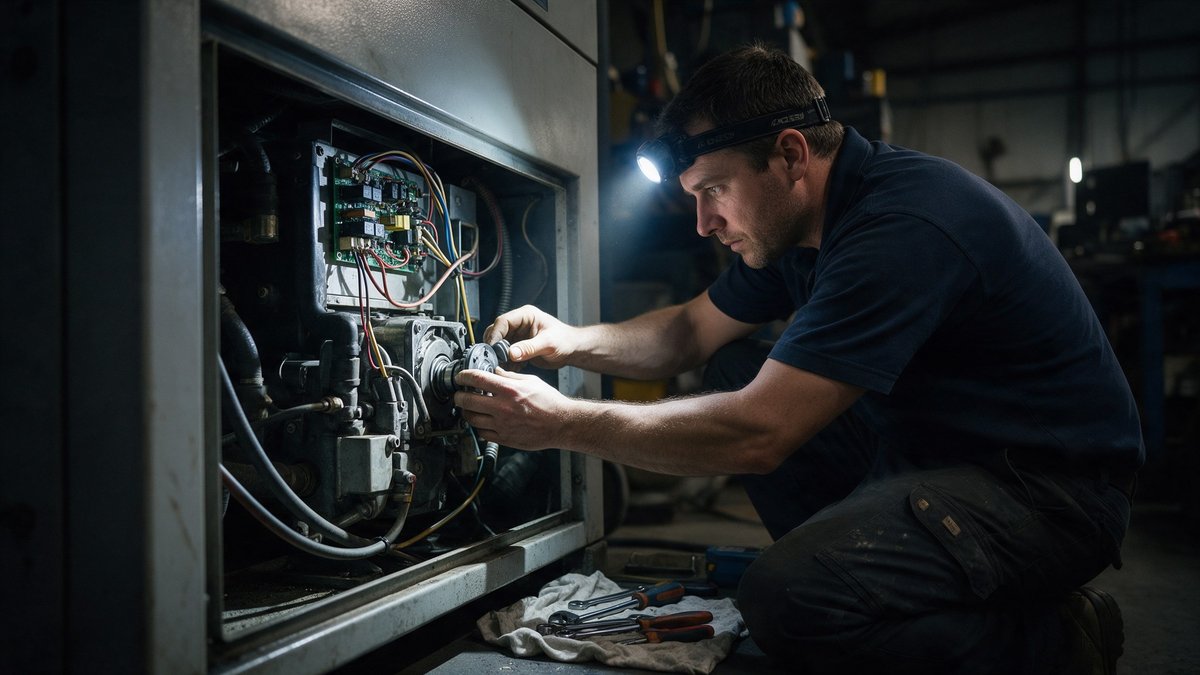
Somewhere right now, an AI lab is paying for strangers’ repairs in three cities. Free labour, no catch, one condition: cameras record every movement an experienced tradesperson makes while they diagnose the fault and fix it. That is not charity and it is not marketing. It is procurement. The lab has models and compute. What it cannot buy off a shelf is a dataset of skilled hands solving messy, real-world problems, so it is manufacturing that dataset by hand, one job at a time.
Your plant floor is full of the same asset. The technician who hears a bearing going before the sensor flags it, the operator who knows which batch will drift. This piece looks at why robotics training data has become the bottleneck in industrial AI, and what capturing your own expertise actually involves.
Your Best Technician’s Knowledge Exists Nowhere Except In Their Hands
Ask your most experienced maintenance tech to write down how they know a compressor is about to fail. They will give you four bullet points and a shrug. The actual knowledge is in pressure, sound, hesitation, the half-second decision to back off a torque wrench. None of it is in your CMMS, your SOPs, or your training deck.
So the trades being filmed are the obvious ones: plumbing, HVAC, electrical, air duct cleaning, carpet cleaning. Work that resists documentation because the variation lives in the hands. Somebody decided that footage was worth subsidising real jobs across three cities to obtain.
That is a price being put on tacit knowledge capture, and it should bother you. Your plant produces the same signal every shift and records none of it. When that technician retires, the dataset leaves in the parking lot.

What the Free-Repair-for-Footage Programme Actually Involves
The structure is simple enough to sketch on a napkin. A homeowner or small business books a job. A qualified technician shows up, does the work properly, and leaves. Nobody pays an invoice. The only obligation on the customer’s side is consent to being recorded, and the recording is of the technician, not the household.
Coverage spans three cities and five service lines: plumbing, HVAC, electrical, air duct cleaning and carpet cleaning. Those aren’t random picks. They are jobs with unpredictable failure modes, confined spaces, and a diagnostic step that happens before any tool comes out of the bag.
The trade of free service for recorded expertise
Strip away the goodwill framing and you have a barter. The lab absorbs labour, parts, travel and insurance; in return it gets hours of expert hands solving problems that were not staged. That cost sits on the books as a data acquisition budget, not a marketing spend.
Run the arithmetic yourself. A tradesperson’s day rate plus materials, multiplied across five disciplines and three cities, for footage that may never produce a shippable product. Any organisation paying that willingly has concluded that real-world task data is now more expensive to obtain than compute. That conclusion should interest anyone sitting on a plant full of it.
Why wearable sensors beat a camera in the corner
A tripod in the room captures what happened. A sensor rig worn on the body captures how it happened: hand position, wrist rotation, approach angle, the exact point of contact, where the eyes were pointed when the decision got made. Fixed cameras lose all of that behind a shoulder or a cabinet door.
There is a second reason, and it matters more for robotics training data. A model learning to manipulate objects needs the viewpoint of the thing doing the manipulating. Third-person footage has to be translated into first-person action; wearable capture skips the translation entirely. Same job, same technician, vastly different data quality.
Why Real Hands in Real Buildings Beat Simulation for Physical AI
Simulation is cheap, fast, and endlessly repeatable, which is exactly why it fails. You can generate a million synthetic pipe joints and every one of them will thread cleanly, because somebody wrote the physics. What you cannot generate is the fitting that has been corroded shut for eleven years, the ductwork that bears no resemblance to the as-built drawings, or the crawlspace where there is no room to turn a wrench and the technician solves it with a forearm and a mirror.
Models trained in clean environments learn clean distributions. They perform beautifully in the lab and then meet a real building, where the variation is not parameterised and nobody updated the schematic. That gap is the long tail, and the long tail is where physical AI dies.
Recording real jobs in real buildings is a deliberate choice to buy the expensive data instead of the cheap data. Field footage is slow to collect, legally awkward, and messy to label. It also contains the only examples that matter: the moments where a competent human encountered something the plan did not account for and improvised a fix that worked.
Manufacturing has the same problem with a different vocabulary. Your normal production runs are the simulation farm. Thousands of hours of everything going right, plenty of data, almost no information. The value sits in the exceptions: the batch that drifted for a reason nobody logged, the weld that passed visual but failed on the second pass, the changeover where the operator compensated for a worn tool without telling anyone.
Those exceptions are rare by definition, which is precisely why they are hard to capture and why most AI deployments stall when they hit them. A model that handles 95% of your quality cases and falls over on the remaining 5% has not reduced your workload. It has added a review step.
If you want an AI system that survives contact with your floor, the robotics training data principle applies directly: collect the hard cases on purpose, while the people who solve them are still there to record.
What Manufacturing and Quality Leaders Should Copy From This Playbook
You do not need a robotics programme to benefit from this. The lab’s method is recording expert work at the moment it happens, and that method transfers to any plant with people who know things nobody wrote down. The capital cost is a few cameras and someone’s time. The opportunity cost of waiting is a retirement date you already have on file.
Which tasks are worth recording first
Pick the three to five tasks where the outcome depends on who is doing it. Not the ones with the longest SOPs, the ones where two qualified operators get different results from the same written procedure. That gap is the knowledge you have never documented.
Changeovers, visual inspection calls, root-cause diagnosis on intermittent faults, and final adjustment on anything hand-finished are the usual suspects. Rank them by what a mistake costs you. Then start with whoever is closest to retirement, because the honest window is now, not eighteen months from now.
Capture formats that stay useful as models improve
Retrospective interviews produce bullet points and shrugs. Capture at the point of work instead: fixed camera on the workpiece, second angle on the hands, audio of the operator narrating decisions as they make them. Timestamp it against your machine data so the footage lines up with pressure, torque, and cycle readings.
Store raw video, not summaries. Summaries are frozen at today’s understanding of what matters; raw footage with sensor context stays readable by whatever model exists in three years. Wearable sensors add force and motion data if you want it, but a GoPro and a clean file naming convention will outperform a stalled procurement process.
The payoff shows up in three places before any AI model does. Onboarding time drops because new hires watch the real job instead of a slide deck. Escaped defects fall where the judgement call was previously undocumented. And you own a dataset of your own operation, which is the one asset in this whole category that nobody can sell you.
Ready to find AI opportunities in your business?
Book a Free AI Opportunity Audit. It is a 30-minute call where we map the highest-value automations in your operation.
The Coming Scramble for Industrial Data Nobody Has Collected Yet
Residential trades were the easy entry point. Access is cheap, consent is a signature, and nobody needs a safety case to film someone under a sink. Factories are harder, which is exactly why the offers will arrive dressed up as partnerships rather than paid gigs. Expect pitches framed around free condition-monitoring pilots, a funded vision system for your inspection cell, or a robotics vendor offering a unit at cost in exchange for data rights.
Read those contracts the way you would read a licensing deal, because that is what they are. The question is not whether the camera helps you this quarter. It is who owns the recording, who owns the model trained on it, and whether your changeover procedure ends up inside a product your competitor buys next year. A story like this one surfacing on Tom’s Hardware rather than in a trade journal tells you the demand is coming from the compute side, not from manufacturing.
So you get two options. Supply someone else’s training set and take a discount for it, or build a proprietary record of how your plant actually runs and keep the asset. The second is not more expensive. It is the same cameras, the same wearable sensors, the same hours of expert time, pointed at your own balance sheet instead of theirs.
In the next quarter, do one thing: audit where the knowledge lives. Walk the floor with a list of your critical processes and mark each one according to whether a competent new hire could run it from the written documentation alone. Most plants find that number is well under half.
Then attach dates. Pull the retirement and attrition profile for the people holding the unwritten half, and treat every name as an expiry date on a capability you have not backed up. That turns tacit knowledge capture into a scheduled operational risk with an owner, rather than an initiative that sits in a deck until the person it depended on stops answering the phone.
Source: tomshardware.com